


.webp)
.webp)
.webp)
.webp)






.webp)



%20(1).gif)
Register for the event
Endowus invites you to our exclusive event with Macquarie Asset Management, as we discuss unlocking opportunities in Infrastructure- a $1.3tn asset class.
This event is reserved for Accredited Investors (AIs) only. To register for the event, please indicate one of the following:
- Passive income from investing is the yield your capital produces — dividends, coupons, and fund distributions — and reaching a monthly target is largely a function of the size of your invested capital.
- Dividend stocks and bonds can both provide payments. The main difference is that equities can grow and offer partial inflation protection in addition to potential income, while being more volatile. Bonds pay more predictable income but are inflation and rate-sensitive.
- Yield is not the same as return — total return is income plus capital movement — and you may not need yield at all, because a portfolio can fund a regular income by selling from its capital growth, which in Singapore is especially efficient since individuals pay no capital gains tax.
Singapore savers who built an income plan on the Treasury bill (T-bill) yields of 2023 are now reinvesting their proceeds into a very different market. The 6-month T-bill cut-off yield had eased to around 1.6% per annum by mid-2026, down from a peak above 4% in 2022 and 2023.
This article argues that the right way to think about passive income is not "which asset yields the most" but "how much capital each level of income requires, and what am I giving up to reach it" — and that dividend stocks and bonds are best understood as complements.
This article sets out what passive income means for an investor, how much capital a given monthly income actually takes, what dividend equities and bonds each pay and where each can disappoint, how the two compare on the dimensions that matter, and how the mix should shift with your time horizon.
What passive income really means for an investor
For an investor, passive income is the income generated without selling the asset - typical examples are dividends from shares, coupons from bonds, and distributions from funds.
How much capital does S$1,000 a month actually take?
A target income divided by a yield gives the capital you need, and the numbers are sobering enough to reframe the whole exercise. The table below shows the capital required to generate three monthly income levels at four illustrative yields.
Read the table across, and the appeal of a higher yield is obvious: a 5% yield reaches S$1,000 a month with less than half the capital that a 2% yield needs. Read it down, though, and the catch appears. Moving from a 2% yield to a 5% yield does not create capital out of nowhere — it accepts more risk to shrink the capital figure, because in markets a higher yield is compensation for something, whether price volatility, credit risk, or a payout that may not hold.
That trade-off, rather than any single "best" yield, is the real subject of the rest of this article. The figures here are illustrative and use round yield bands; actual yields move, and none of these numbers is a promised return.
Dividend stocks pay you a share of profits — until they don’t
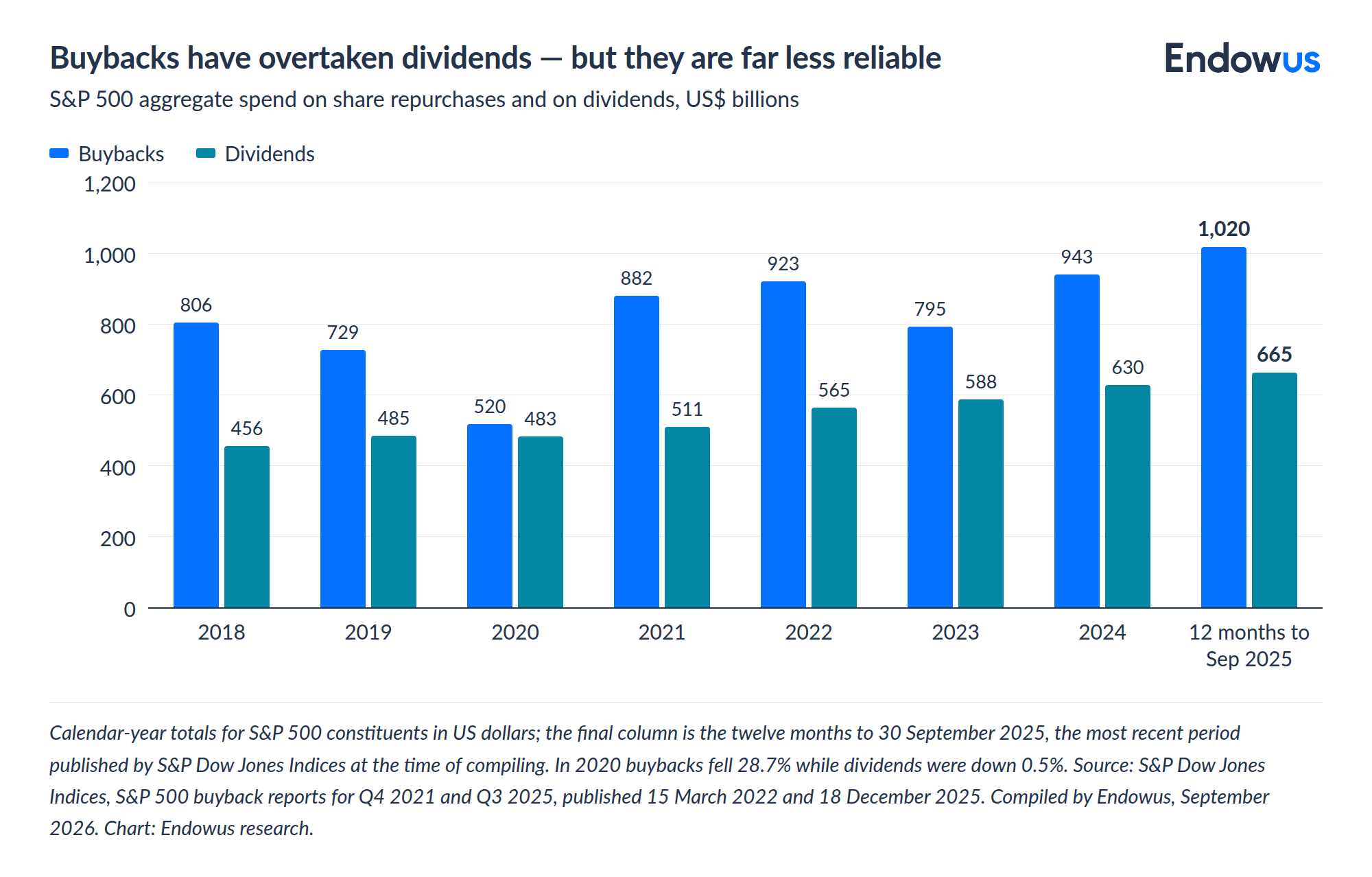
A dividend is a share of a company’s profits paid to shareholders, usually quarterly or half-yearly. The decision to pay a dividend is made by the company’s board of directors, and can be rescinded or amended at any time. In addition, more recently companies are prioritizing stock buybacks - which are the same as dividends for the company and have a boost on the stock’s price.
In that last case, however, returns can only be realized by selling shares and pocketing capital gains. But while the book value of a shareholder’s position post-dividend is the same as post-buyback, market value does not necessarily react with that level of precision. So ultimately, buybacks may not offer the same returns as dividends.
At the index level, Singapore’s market has historically been one of the higher-yielding in the region: the SPDR Straits Times Index (STI) ETF has a dividend distribution yield of 3.03%. This dividend yield reflects the composition of the local market, which is financials and real estate investment trusts (REITs)-heavy while lacking high-growth tech companies, which typically provide no dividends but have higher appreciation potential.
When those sectors do well, the income is generous; when they do not, both the payouts and the prices can fall together.
As a reminder, a dividend is a fraction of the profit the company decides to redistribute, rather than reinvest or store. It is a complex, delicate decision that has pros and cons, and can never be taken for granted.
If the payout ratio — the share of earnings paid out as dividends — is too high, the company may give itself little leeway in case profits decrease. A company that has accustomed investors to rely on a high-dividend payout will likely suffer from a market selloff should it choose to decrease the dividend or cease it altogether.
To avoid that, some companies borrow in order to finance dividend payments, or use their accumulated reserves. Intuitively, however, a dividend backed by growing profits is more durable than one funded by borrowing or by running down reserves.
One element to keep in mind is that a company’s equity price adjusts post-dividend payment (“ex-dividend” adjustment). And when the company is not generating enough profit, repeated borrowing to pay dividends may decrease demand for the stock, as it decreases potential future cash flows.
Our guide to dividend investing for beginners covers how to judge payout quality; the useful question is not which share yields most, but whether the income is covered and the exposure spread.
Bonds pay a coupon, but two risks are easy to miss
A bond pays a fixed coupon and, for an individual bond held to maturity, returns your principal with the last payment. That theoretical predictability is what makes bonds the potential basis of an income portfolio. Two risks, however, are easy to overlook.
The first is interest-rate risk. When rates rise, the market price of an existing bond falls, because future cash flows (coupons) are discounted at higher rates; the higher the bond’s duration, the sharper is that price move. An investor who may need to sell before maturity is exposed to this, even on a government bond.
This is an excerpt from one of our educational articles:
For investors, duration has a practical aspect: it quantifies how much “rate” risk you are taking in a fixed income portfolio - in other words, how sensitive is your portfolio to changes in interest rates. A portfolio with an average duration of 10 years is taking meaningfully more interest rate risk than one with an average duration of three years.
The second is credit risk, the chance the issuer cannot pay. This is typically compensated by a “spread” - a higher coupon compared to government bonds from the same country.
Again, from our educational series on fixed income:
A credit spread is the extra yield a bond pays over a comparable government bond — the market's price for credit and liquidity risk… Calm is not the state that defines (corporate bonds). The high-yield spread reached roughly 21.82% in December 2008 and spiked to about 10.87% on 23 March 2020 (Ice Data Indices, via FRED).
There is a third issue - reinvestment risk. As the T-bills and fixed deposits bought in 2023 mature, the proceeds may be reinvested at materially lower rates. Singapore Savings Bonds (SSBs) remain a useful anchor for retail investors — the October 2026 issue offered a 10-year average return of about 2.3% per annum — and both SSBs and T-bills are covered in our existing guides.
For most investors, a bond fund may be the more practical route than buying individual bonds, because it spreads issuer risk across many holdings. The trade-off to understand is that a bond fund has no single maturity date. The fund buys and sells bonds and its price and income vary with the bonds it holds and with the level of rates.
Dividends versus bonds, side by side
Set the two income assets against each other on the dimensions that actually decide an income plan, and the case for holding both becomes clear. Neither wins outright; they fail in different places.
Under Singapore’s one-tier corporate tax system, dividends from Singapore-resident companies are generally not taxable for individual investors, and interest from SSBs and T-bills is generally tax-exempt too. The nuance is foreign income: overseas dividends may be taxed at source before they reach you, and fund distributions can differ. Confirm these lines against the Inland Revenue Authority of Singapore (IRAS) before relying on them.
Is yield the same as return?
No. Total return is income plus the change in the capital’s value - a capital gain or a capital loss.
Suppose a fund pays out 6% over a year, but the value of its holdings falls 4% over the same period. The income looks healthy, yet the total return is roughly 2%, and the capital base that produces next year’s income has shrunk. Some funds also fund part of their distribution from capital rather than income, which flatters the headline yield while reducing the principal. This feature is legitimate and disclosed, but it can be overlooked.
There is a further step most income-seekers miss: you may not need yield to draw an income at all. A portfolio built for total return can fund spending by selling, realising a small slice of capital from time to time, sometimes called a "homemade dividend". A dividend, after all, is not free money: when a company pays one, its share price typically falls (or foregoes future gains), so taking S$1,000 in dividends or selling S$1,000 of shares can leave you, before costs and tax, in much the same position. For a Singapore investor there is the additional perk that Singapore does not tax capital gains for individuals. Realising gains to fund income may be both tax-efficient and flexible, since you choose the timing and the amount rather than taking whatever a company or fund decides to distribute.
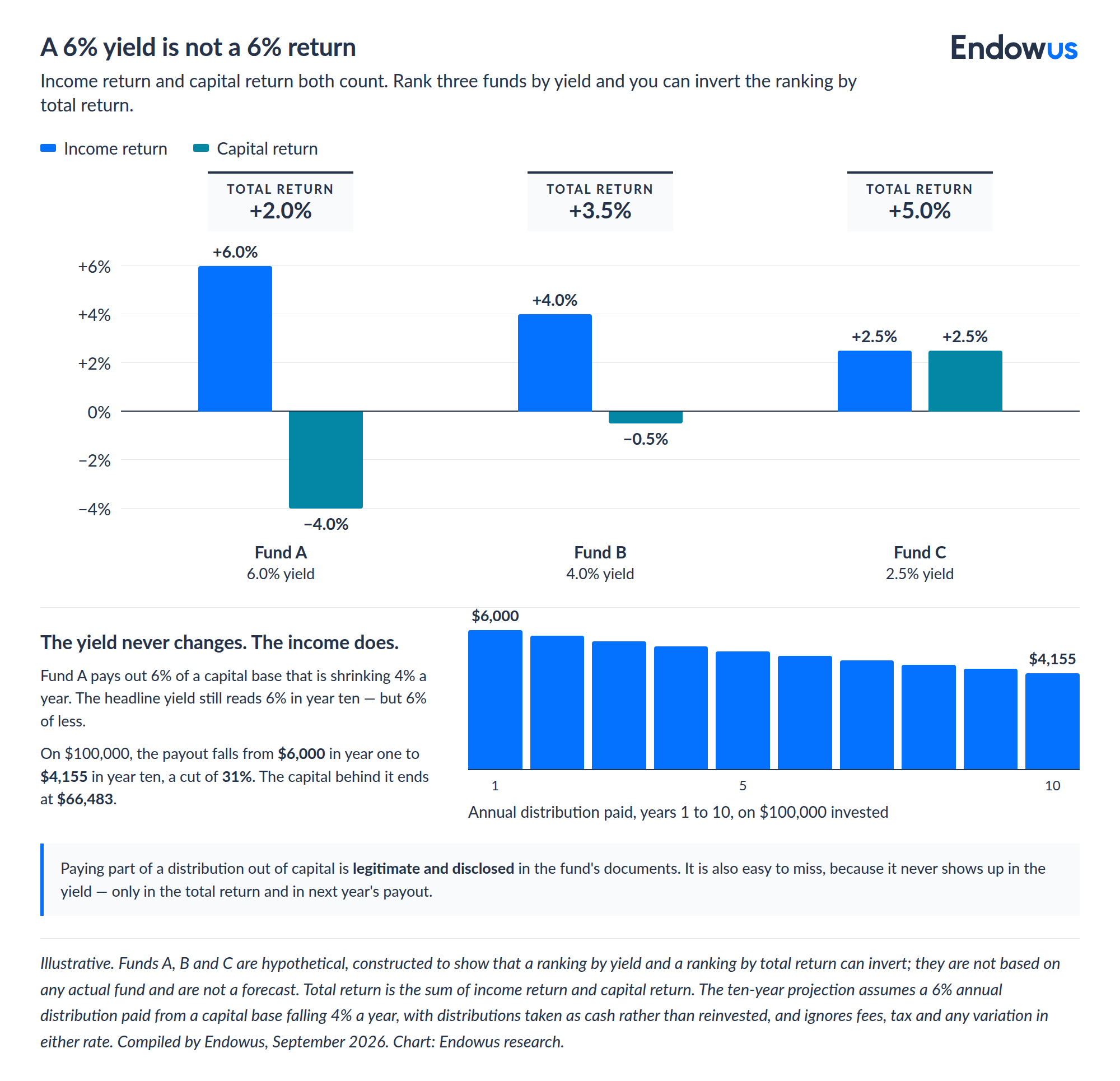
Two practical rules follow. An unusually high yield may reflect a genuinely higher-yielding asset or mask a falling price. And treat income as a decision about cash flow, not a feature provided only by certain assets: what matters is the total return your capital earns, net of fees and tax, rather than the form in which you draw it.
The right mix depends on when you need the money
The most common mistake in income investing is reaching for payouts too early. An investor 20 years from retirement usually does not need income at all: reinvested total return compounds faster than payouts spent along the way, and tilting a young portfolio toward high-yield assets sacrifices potential growth.
Income can be a “nice to have” - to supplement expenses, for instance, but needs to be a conscious investment choice. As a reminder, selling to fund spending may look doable and harmless while markets rise, but selling after a sharp fall realises losses and can permanently shrink the capital that has to last — a danger known as sequence-of-returns risk.
If that income is not used for consumption purposes, however, it will have to be reinvested and will thus be prone to “reinvestment” risk (see above.)
In conclusion, while income generating assets may have pros and cons through an individual’s working life, they become a significant component of a portfolio during retirement. Indeed, a buffer of bonds and steady distributions may allow a retiree to meet spending needs without selling growth assets at the wrong moment, leaving those assets alone until they recover.
Investment implications
In our view, the most important discipline is to separate the income question from the growth question and to size each asset to the job it does, rather than buying whichever product advertises the largest distribution.
For investors still accumulating, a globally diversified growth allocation such as the Endowus Flagship Portfolios does more work than an income tilt: a portfolio compounding through capital appreciation does not need to manufacture income at all, and gains can be realised to fund spending later — tax-free for Singapore individuals — if and when the need arises. Money needed within a year or two can sit in a lower-risk cash solution such as Endowus Cash Smart rather than being stretched for yield. For those at or near drawdown, the Endowus Income Portfolios are built to pay a regular monthly distribution, with current target payouts of 5.0% to 6.0% per annum on the Stable Income and Higher Income portfolios and 3.5% to 4.5% per annum on Future Income1. Endowus Cash Smart is not a bank deposit and is not capital guaranteed. The Cash Smart Portfolios invest in money market funds and short-duration fixed income funds, which carry market risk; their value can fall as well as rise. Yields are not guaranteed, are not a forecast of future returns, and vary with market conditions and with the underlying funds held.
On the one hand, dividend equities offer income that can grow and a measure of inflation protection, but equities typically also carry higher volatility. On the other, bonds typically offer steadier, more predictable income, but are subject to inflation reducing returns.
A sound solution would be to target total return, net of taxes and fees, while holding enough dividend stocks and bonds to avoid selling growth assets at the wrong time to generate income.
Frequently asked questions
How much do I need to invest to generate S$1,000 a month in Singapore?
It depends entirely on the yield you can sustainably earn. At a 3% yield you would need about S$400,000; at 5%, about S$240,000. A lower capital figure implies a higher yield, and a higher yield implies more risk.
Are dividends taxable in Singapore?
For individual investors, dividends from Singapore-resident companies are generally not taxable under the one-tier corporate tax system, and interest from SSBs and T-bills is generally tax-exempt. Foreign dividends may be taxed at source before you receive them, and fund distributions can differ, so confirm your situation with IRAS.
Is a higher dividend yield always better?
No. A very high trailing yield may reflect a falling or flat share price rather than a generous, sustainable payout. What matters is whether the income is covered by earnings and whether the total return — income plus capital movement — holds up.
Are dividend stocks safer than bonds?
Neither is "safe"; they carry different risks. Dividend equities are more volatile in price and their payouts can be cut, while bonds offer steadier income but lose real value to inflation and fall in price when rates rise. Most income investors hold both for that reason.
How can I start earning passive income from investments in Singapore?
Begin with your horizon and the capital you can commit, then match assets to the job: growth assets while accumulating, more stable income assets as you approach drawdown, and a cash solution for money needed soon. A diversified fund portfolio spreads the risk that any single holding cuts its payout.
1 Current payout targets are not guaranteed and are estimates only. They may be revised, the distribution may include a return of capital, and total return can be lower than the payout rate.
Retiring with a bucketing strategy

Webinar: Wealth — the wellness trend for women

Sparking joy: How to Marie Kondo your finances



%20F1(2).webp)

.webp)
.webp)






.webp)