


.webp)
.webp)
.webp)
.webp)






.webp)



%20(1).gif)

Register for the event
Endowus invites you to our exclusive event with Macquarie Asset Management, as we discuss unlocking opportunities in Infrastructure- a $1.3tn asset class.
This event is reserved for Accredited Investors (AIs) only. To register for the event, please indicate one of the following:
- The Baby Bonus Scheme currently gives eligible families $20,000–$38,000 per child in cash and CDA support, but it will be replaced by the SG Child Support Package (around $70,000 per child) from 1 April 2027.
- Parenthood tax reliefs—the Parenthood Tax Rebate, Qualifying Child Relief, and Working Mother's Child Relief—can reduce a family's income tax bill by thousands of dollars a year, and are often under-claimed.
- Starting a low-cost, globally diversified investment portfolio early, even from $1,000, gives your money more time to compound before costs like tertiary education arrive.
The cost of raising a child in Singapore is commonly estimated at $170,000 to over $1 million by the time they turn 21, depending on lifestyle, schooling choices and family circumstances. For parents adjusting to disrupted sleep and a reshuffled budget, that range can feel daunting.
This guide breaks down what to expect at each stage of your child's life, from infancy to university, and how government schemes, tax reliefs and early investing can help you plan for it.
Financial milestones as a young parent
Housing costs for a young family
Singapore residents' median gross monthly income, including employer CPF contributions, was $5,775 in 2025, according to the Ministry of Manpower's latest Comprehensive Labour Force Survey figures.
Mortgage rates have swung significantly since 2021. After peaking above 3% in 2022–2023, fixed home loan rates have since fallen back to roughly 1.3%–1.8% as of August 2026, with the HDB concessionary loan rate holding at 2.6%.
New parents planning to buy or upgrade their home also stand to benefit from housing measures announced at the 2026 National Day Rally. The income ceiling for Build-To-Order (BTO) and Sale of Balance flats, the CPF Housing Grant, and HDB loans has been raised from $14,000 to $16,000. The ceiling for new Executive Condominium (EC) units has been raised from $16,000 to $18,000. From the February 2027 sales exercise, families will also receive an additional ballot chance for each Singapore Citizen child aged 18 and below.
On top of that, there are other expenses that you may incur when you have your own residence. Here is a list of costs that you will face as part of your housing needs, on a monthly basis:
Examples of monthly expenses specific to a new residence
What is the cost of raising a child in Singapore?
The cost of raising a child varies widely, with total costs from infancy to 21 years of age commonly estimated to range from $170,000 to $340,000, and sometimes cited as high as $1,000,000. This is a widely repeated planning range rather than a figure from one official study, so your actual costs will depend heavily on schooling, insurance, and lifestyle choices.
One key thing to note is that the cost of raising a child does not necessarily have a fixed pattern to it—it does not increase in a linear way, or remain constant.
We can broadly categorise and estimate the spend based on how much it costs to raise an infant, a toddler, and a child in primary, secondary, and tertiary education.
Common costs of raising an infant (0-2 years old)
The first few years of raising a child can be characterised by childcare costs, enrichment classes, and paediatrician visits, whereas the later years may be dominated by expenses such as tuition and university fees.
Apart from basic necessities like food, diapers, toys, and clothing, common expenses* to anticipate are:
- Confinement nanny: ~$3,880 for every 28 days
- Childcare: ~$690–$1,370
*Figures are estimates. Childcare figures are ECDA's regulated fee caps at Anchor and Partner Operator centres, before any subsidy; Partner Operator rates fell further from 1 January 2026. Confinement nanny cost based on a MOM-licensed confinement agency's published rates, which start from around $3,880 for 28 days and can range roughly $3,500–$5,000 depending on the agency.
These monthly and one-off costs can still add up to a significant sum over the first two years of raising your child, before any government support is factored in.
The good news is that a meaningful share of these costs can be offset. Baby Bonus, and its upcoming replacement, the SG Child Support Package, together provide $20,000 to $70,000 or more in government support per child—we cover this, and other 2026 family support measures, in detail further down this guide.
Still, it is worth having long-term savings plans in place too, especially for the later years in life when more significant costs such as tertiary education are included.
Common costs of raising a pre-school child (3-6 years old)
As your child gets ready for pre-school, they may also need enrichment classes.
Common expenses for a 3-6 year old child*
- Childcare: $610–$650 a month for full-day childcare (ages 3-4)
- Pre-school from $150 a month for kindergarten (ages 5-6)
- Enrichment classes
*Childcare figures are ECDA's regulated fee caps at Anchor and Partner Operatorcentres, before any subsidy; Partner Operator rates fell further from 1 January 2026. The $610 (Anchor Operator) and $650 (Partner Operator) full-day childcare caps and the $150 kindergarten cap took effect on that date.
Parents stand to benefit from extra paid childcare leave and planned reductions in preschool fees, both announced at the 2026 National Day Rally—covered in the next section.
In addition, money in your kid's Child Development Account (CDA) can be used to directly offset preschool and healthcare expenses—more on this later.
Primary school education costs (7-12 years old)
Monthly cost of primary school in Singapore (2026)
Monthly expenses
When your child progresses to primary school, you will save on expensive school fees, since primary school fees are largely subsidised for Singaporeans. In exchange, though, expenses arise in the form of pocket money and transport costs.
Yearly expenses
Some of the yearly expenses you can expect include textbooks, school uniforms—especially if your child changes uniforms frequently—and miscellaneous expenses such as school outings and co-curricular activities.
Secondary school education costs (13-16 years old)
Monthly cost of secondary school in Singapore (2026)
The type of expenses to support a child in secondary school is very similar to that of a primary school child, although the amount for each expense would be larger.
Tuition or enrichment classes, pocket money, and course materials will also be more expensive as your child climbs up the academic ladder.
Post-secondary education costs (17 years old and above)
After secondary school, students will likely enrol in a junior college (JC), a polytechnic, or the Institute of Technical Education (ITE).
Cost of post-secondary education in Singapore (2026)
Tuition centre costs
There's no official rate-setter for private tuition, so prices vary by tutor and agency, but median hourly rates in Singapore are approximately $30 for primary school classes, $40 for secondary school classes, and upwards of $55 for junior college classes. More prestigious tuition centres and private tutors can cost much more due to high demand.
According to the Department of Statistics' Household Expenditure Survey in 2023, the average monthly household expenditure on private tuition and education courses was $127.
University costs (19 years old and above)
Depending on the course and school, annual tuition fees for Singapore Citizens at a local autonomous university in 2026 range from around $8,000 for most undergraduate programmes to $54,000 for medicine, after the MOE Tuition Grant. Additional costs would be accrued if your child stays on campus or goes for overseas exchange trips.
How is the government helping new parents manage these costs?
New parents in Singapore can currently rely on the Baby Bonus Scheme, and its replacement, the SG Child Support Package, on top of extra childcare leave and falling preschool fees—measures designed to directly offset many of the costs covered above.
The Baby Bonus Scheme and SG Child Support Package
Under the current Baby Bonus Scheme, eligible families receive a Baby Bonus Cash Gift of $11,000 for the first and second child, and $13,000 for the third child and beyond, alongside Child Development Account (CDA) grants and government co-matching. Combined, this comes to $20,000 for a first child, $23,000 for a second, and up to $38,000 for a fifth or subsequent child.
This scheme is being retired, though. At the 2026 National Day Rally, the Government announced that the Baby Bonus Scheme and Large Families Scheme will be replaced by a new SG Child Support Package from 1 April 2027.
Every Singapore Citizen child, regardless of birth order, will receive around $70,000 in support from birth to age 17:
- $10,000 Baby Gift,
- $5,000 MediSave grant
- $5,000 in CDA First Step Grant plus up to $5,000 in dollar-for-dollar co-matching
- $2,000 a year in Child Credits from age 1 to 16
- About $2,500 in Edusave contributions through school,
- $10,000 Post-Secondary Education Account top-up at 17.
Children currently receiving the Baby Bonus Cash Gift will transition automatically into the new package.
More childcare leave and lower preschool fees
Also announced at NDR 2026: working parents will receive more paid childcare leave—8 days for one child, 10 for two, and 12 for three or more, per working parent, up from the current 6 or 2 days.
Full-day childcare and infant care fees at Government-supported centres are also set to fall further, to $150 and $300 a month respectively by 2030, with subsidies extended to families regardless of the applicant's working status.
In addition, money in your kid's CDA can be used to directly offset preschool and healthcare expenses.
Taken together, these schemes mean a large share of the costs above won't fall entirely on your own pocket—but it's still worth budgeting as though they might, and treating government support as a buffer rather than the plan itself.
Saving and investing for your kid's university education fund
As a young parent, you are likely to face the challenge of being part of the sandwich generation—with your children as well as elderly parents or in-laws as your dependents. Beyond fire-fighting for daily expenses, it is also important that you plan for both your and your child's longer-term financial needs.
Traditional university savings plans or endowment products may seem attractive due to the low investment risk and how the payouts are structured to meet cash flow needs to pay off university tuition fees, but they typically have early withdrawal penalties and lower returns.
Alternatively, you can get started building a low-cost portfolio of funds from as low as $1,000. From there, you will be given a portfolio based on the risk tolerance of your investment goals. If your financial needs change, there will be no sale charges or termination fees when you redeem your investment.
To get started with Endowus, click here. Our Flagship Portfolios are where you can begin to build your investing journey, and allow your returns to compound over time.
Building a tertiary education fund with CPF
If you do not have much cash to invest, you can also invest your CPF to plan for your kids' local tertiary education, as Central Provident Fund (CPF) savings can be used to pay for education under the CPF education loan scheme. This can be used to pay for any full-time subsidised undergraduate courses and diploma courses from the polytechnics and other educational institutions.
Similarly, Endowus offers a low-cost, globally diversified portfolio for CPF investments as well.
How can the Child Credits help you start investing early for your child?
As covered above, the incoming SG Child Support Package includes $2,000 a year in Child Credits from age 1 to 16—$32,000 in total, intended to help cover costs like childcare, enrichment and school expenses.
Since this support reduces what you would otherwise spend out of pocket on those same items, it can free up room in your own budget. Rather than letting that freed-up amount go towards discretionary spending, you may consider redirecting it into a long-term investment for your child instead. A Singapore Citizen child has years, often over a decade, before major costs like tertiary education arrive—time that lets even modest, consistent contributions potentially compound.
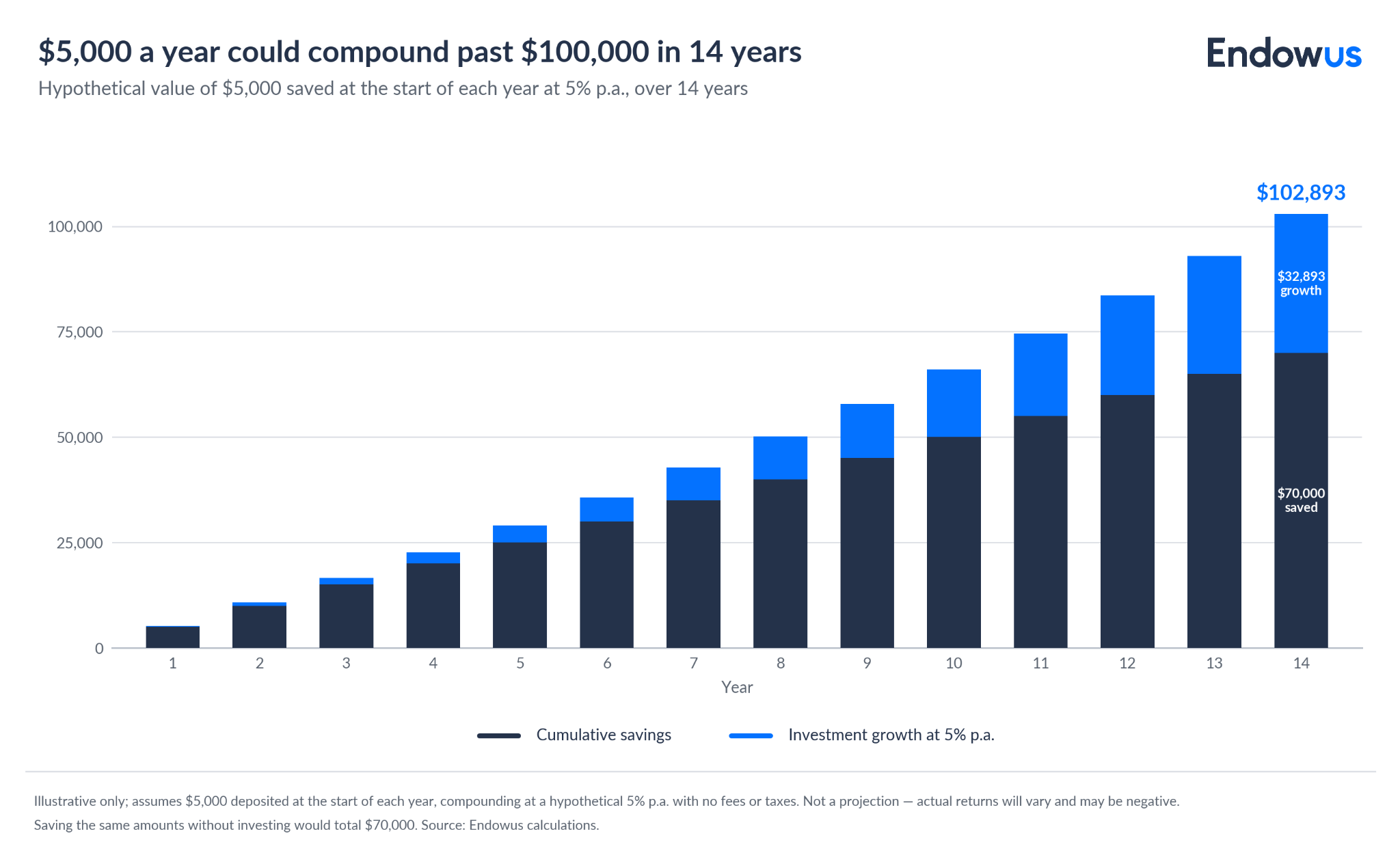
This doesn't need to be complicated. You may consider starting a low-cost, globally diversified portfolio, such as Endowus's Flagship Portfolios, with whatever you're able to set aside each year. Starting early, even with small amounts, gives your child's future fund more time in the market than waiting until they reach secondary school or later.
What tax reliefs can new parents claim in Singapore?
New parents in Singapore can claim several tax reliefs and rebates that directly reduce the household's income tax bill, on top of any Baby Bonus or CDA support.
Parenthood Tax Rebate (PTR): a one-off rebate of $5,000 for your first child, $10,000 for your second, and $20,000 for your third and each subsequent child, applied against tax payable rather than taxable income. Unused PTR carries forward automatically until fully used, and can be shared between spouses.
Qualifying Child Relief (QCR): an annual relief of $4,000 per child, or $7,500 under Child Relief (Disability) for a child with special needs, claimable by either parent or split between them.
Working Mother's Child Relief (WMCR): available to married, divorced or widowed working mothers of Singapore Citizen children. For children born or adopted from 1 January 2024, WMCR is a fixed $8,000 for the first child, $10,000 for the second, and $12,000 for the third and each subsequent child. For children born earlier, it's instead calculated as 15%, 20% and 25% of the mother's earned income by birth order, capped at 100% of her earned income.
Combined, QCR (or Child Relief (Disability)) and WMCR are capped at $50,000 per child, and total personal income tax reliefs are capped at $80,000 per Year of Assessment, per IRAS. For a family with a modest income, these reliefs alone may be worth thousands of dollars in tax savings a year.
Take that first step, no matter how small
Raising a child in Singapore is neither cheap nor easy, and the cost of raising a child will keep shifting as schemes like the Baby Bonus give way to the SG Child Support Package and school fees are revised. Starting your financial planning early, and letting compounding work in your favour, matters more than getting every projection exactly right.
Beyond the numbers, instilling good money habits in your children may be one of the most valuable things you pass on. If you're ready to start investing towards their future, you may consider building a low-cost, globally diversified portfolio with Endowus's Flagship Portfolios, starting from $1,000.
Frequently asked questions
Does it cost $1 million to raise a child in Singapore?
Estimates vary widely, from around $170,000 to over $1 million by age 21, depending on schooling, enrichment, healthcare and lifestyle choices. There's no single official study behind an exact figure—treat it as a planning range, not a target.
How is the Baby Bonus paid out?
The Baby Bonus Cash Gift is disbursed every six months until your child turns six-and-a-half. This applies to the current scheme; children born from 1 April 2027 will receive the SG Child Support Package instead.
What is the Baby Bonus for 2026?
Currently $11,000 for a first or second child and $13,000 for a third or subsequent child, plus CDA grants and co-matching. From 1 April 2027, this is replaced by the SG Child Support Package, worth around $70,000 per child.
How much is child relief for income tax in Singapore?
Qualifying Child Relief gives $4,000 per child a year. Combined with Working Mother's Child Relief and the Parenthood Tax Rebate, a family could reduce their tax bill by several thousand dollars per child.
What to know about and do with CPF as a fresh graduate
.png)
Money Diaries — A "Money Optimiser" with a wedding to plan and a house to buy

Money Diaries — Everyday Singaporeans and their money



%20F1(2).webp)

.webp)
.webp)






.webp)