


.webp)
.webp)
.webp)
.webp)






.webp)



%20(1).gif)

Register for the event
Endowus invites you to our exclusive event with Macquarie Asset Management, as we discuss unlocking opportunities in Infrastructure- a $1.3tn asset class.
This event is reserved for Accredited Investors (AIs) only. To register for the event, please indicate one of the following:
- The outcome of China’s artificial intelligence (AI) race against the US is only one of the potential drivers of long-term Chinese equities performance. Robert Gilhooly, an economist at Aberdeen Investments, compared it against the dot-com era, which had no clear winner.
- Neijuan (loosely translated to “involution”), weak consumption, and falling property prices are structural risks to China's long-term growth, not temporary setbacks, which is why Beijing appears to have made addressing them a policy priority.
- A potentially more sustainable approach for investors is to diversify across China's onshore and offshore markets, and to allocate to China as part of a broader global portfolio, rather than to place concentrated bets on AI or any single narrative.
Much of the current case for investing in China leans on the idea that China is closing in on the US, or even winning the artificial intelligence (AI) race. It is a compelling narrative increasingly used to justify a long-term allocation to Chinese equities.
This is a limiting perspective.
Winning the AI race is the wrong lens for a long-term China thesis
Robert Gilhooly, Senior Emerging Markets Economist at Aberdeen Investments described AI as a commercially-driven, general-purpose technology that diffuses gradually across economies, closer to the spread of electricity than to a single symbolic event such as what happened with the space race.
On model development, the US remained "slightly ahead," per Gilhooly, with its models occupying the top two spots on one leading benchmark. China has closed the gap quickly, aided by a large pool of science, technology, engineering, and mathematics (STEM) talent. Its preference for open-source models, against mostly closed US models, could support faster global adoption even without technical leadership.
Government support differs by design, but it is substantial in both markets. The US leans on light-touch regulation paired with export controls on advanced semiconductors, preserving its compute advantage. China's approach is more directly state-directed, with subsidised energy and credit steered toward strategic sectors.
The clearest divergence is that China's manufacturing base makes up around 25% of its economy, against under 10% in the US. Its AI strategy is aimed at that base: industrial automation, robotics, and what Gilhooly calls "world models" for interpreting the physical world. The US, in contrast, remains more focused on frontier model capability aimed at general intelligence, a costlier and less certain bet, but one that reflects America’s passion for “moonshots.”
With all that said, Gilhooly questions whether "race" is even the right analogy, pointing to the "internet race of the late 90s or early 2000s" and asking "was there really a clear winner." His conclusion: AI "will change the structure of economic activity in both countries" much as the internet did—as a by-product of this competitive endeavor.
China's AI investments are still in a "light return" phase
Even setting the race framing aside, China's own AI companies are not yet showing clear returns in their numbers. Rising research and development spending has yet to be reflected in profits, as it is expected for such early-stage firms. JPMolight return phasergan Asset Management's mid-2026 outlook frames large Chinese internet platforms as in a "heavy investment, light return" phase.
As it has been apparent in H1 2026, AI capex is climbing faster than the advertising, cloud, and AI-application revenue needed to justify it. There has been a shift in market attention, from software and platform "optionality" toward the hardware enablers underneath it, including chips, servers, power infrastructure, and North Asian supply chains.
China's business landscape is shaped by a long-term push for technological self-reliance
Separate from its response to specific economic pressures, Chinese policy also operates on a longer strategic horizon. China's 15th Five-Year Plan (2026–2030) commits to 7% annual growth in research and development (R&D) spending on integrated circuits, AI, bioengineering, quantum computing, and nuclear fusion. The National People's Congress approved the plan in March 2026, following the Chinese Communist Party's Fourth Plenum the previous October. It extends the ambitions first set out under Made in China 2025 (MIC25), which targeted self-sufficiency across 13 critical technologies.
China has achieved global leadership in five of those 13 technologies, according to Bloomberg's own assessment, which are high-speed rail, graphene, drones, solar panels, and electric vehicles and lithium batteries. It is still closing the gap in the rest, which includes frontier AI compute and advanced semiconductors, consistent with the AI race discussion above.
Based on global fund manager Franklin Templeton’s assessment, the plan's core strategy prioritises national economic security over efficiency. That is itself a relevant consideration for investors: capital directed by strategic priority does not automatically generate the same shareholder returns as capital directed purely by profit.
Involution, weak consumption, and falling property prices are long-term structural risks
Three key domestic pressures carry consequences well beyond China’s AI progress, which is why they have drawn direct policy responses from Beijing. Each is worth understanding on its own terms, including why it matters and how policymakers are responding.
Involution
Neijuan (loosely translated to "involution") describes cutthroat domestic competition in which rising effort produces shrinking returns. It matters for equity investors because a sector can expand output and market share while individual companies, and their shareholders, see margins compressed rather than improved. Overcapacity built up across electric vehicles (EVs), solar panels, and steel, driven in part by the same industrial policy that built China's manufacturing scale.
Involution can permanently impair an industry's profitability even as volumes keep expanding, which is why Beijing has intervened directly. In 2025, Xi Jinping's Central Financial and Economic Affairs Commission made "governing disorderly low-price competition" a policy focus. China's legislature is also preparing its first amendments to pricing law in nearly three decades, giving the government power to define and punish unfair pricing.
Despite this, progress has been slow with concerns over potential job losses and slower economic growth. Morningstar estimates that anti-involution policies may take two years for results to materialise, and are contingent on improving domestic demand.
Weak domestic consumption
China's growth model has long leaned on investment and exports rather than household spending. That is relevant for public equity investors, as many listed Chinese companies, including retailers and e-commerce platforms, depend directly on consumer spending for revenue.
Weak consumption growth has been a structural drag on earnings for these companies for several years. China's domestic consumption expenditure has been stagnating in the range of 34-40% for the last two decades, and with declining population potentially causing additional issues going forward.
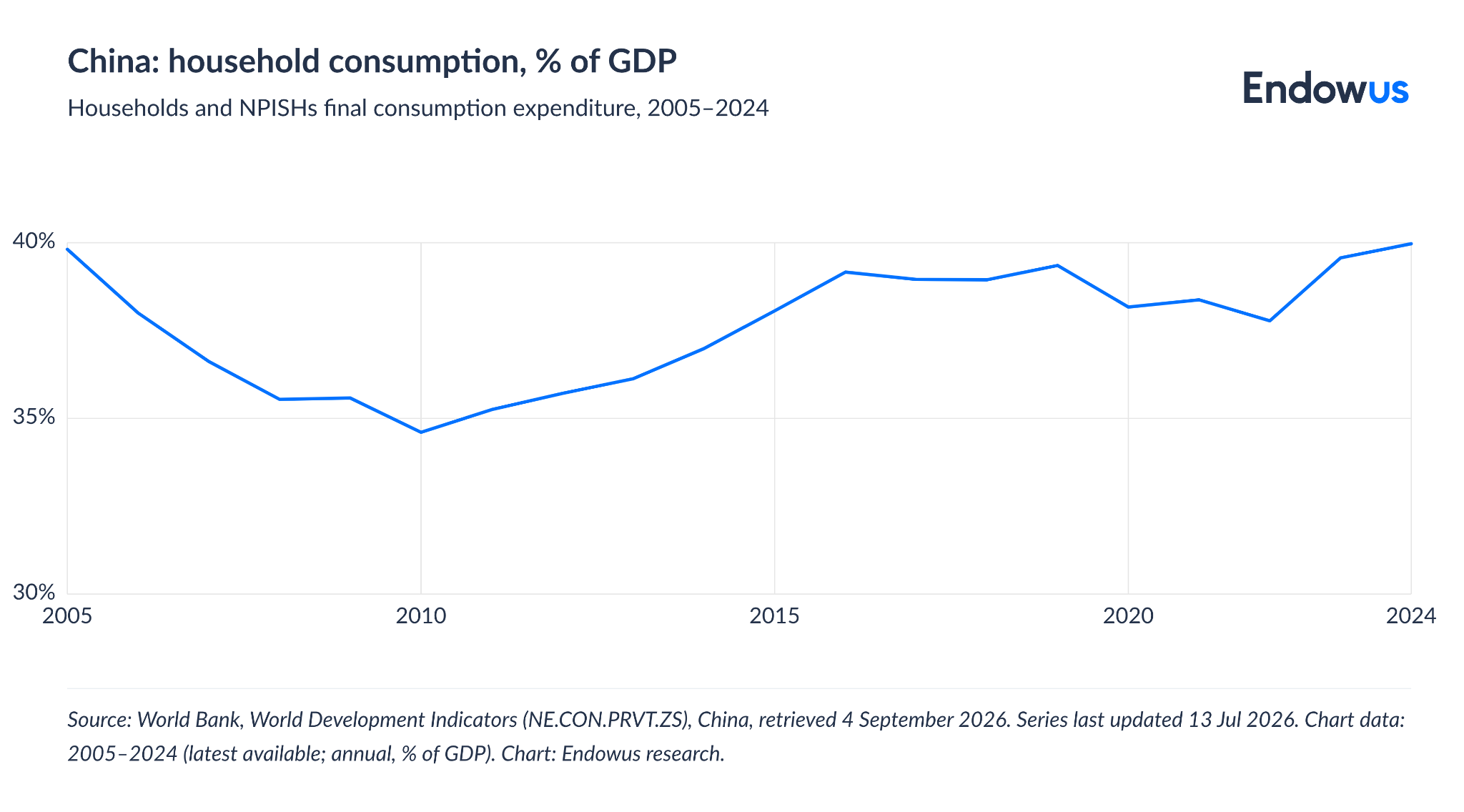
Retail sales grew just 3.7% in 2025, a modest improvement on 2024, and only 1.4% over the first five months of 2026. Growth slowed sharply within 2025 itself, from 6.4% year-on-year in May to 1.3% in November, as local consumption-subsidy budgets ran out.
Beijing has funded a consumer goods trade-in subsidy programme since 2024, allocating a further CNY250bn (approximately US$36.3bn) for 2026. The programme has been effective when funded: exhausted local budgets contributed to an 8% fall in November 2025 auto sales, a normally strong month.
Such incentive is “transitory”, as the Peterson Institute noted, and a shift in focus to more sustained, long-term demand is evidenced by increased social insurance expenditures, which more than doubled as a share of GDP from 3.6% in 2010 to 7.7% in 2023. This fiscal commitment is expected to boost domestic demand, alongside increased wages as a result of a shrinking working population.
Falling property prices
Falling home values make households feel poorer and cut spending even when their income has not changed, an effect economists call the wealth effect. This hits China harder than most economies, for two reasons. First of all, property makes up close to 70% of Chinese household wealth, and capital controls also limit where else Chinese households can put their savings. A 10% drop in home prices cuts Chinese household spending by roughly 1.5–2.3%, against just 0.6% in 1990s Japan—which was in and of itself one of the most profound real estate crises in global history.
The People's Bank of China cut structural policy rates and lowered the minimum down payment for commercial mortgages to 30% in early 2026. A separate "whitelist" lending scheme had channelled RMB 7 trillion to unfinished housing projects as of September 2025.
However, it remains an unsolved problem as of the date this article was first published.
The more durable answer is diversification rather than concentrated bets—including in AI
In recent years, there has been a resurgence of interest in China equities with several high-profile IPOs. ChangXin Memory Technologies (CXMT), China's largest DRAM memory chipmaker, raised US$8.6 billion, against its US$4.3 billion target, at the STAR Market IPO in July 2026, making it the most valuable China-listed company.
Adding China to a technology position offers exposure to a different part of the innovation chain: hardware manufacturing, semiconductor foundries, power equipment, and robotics.
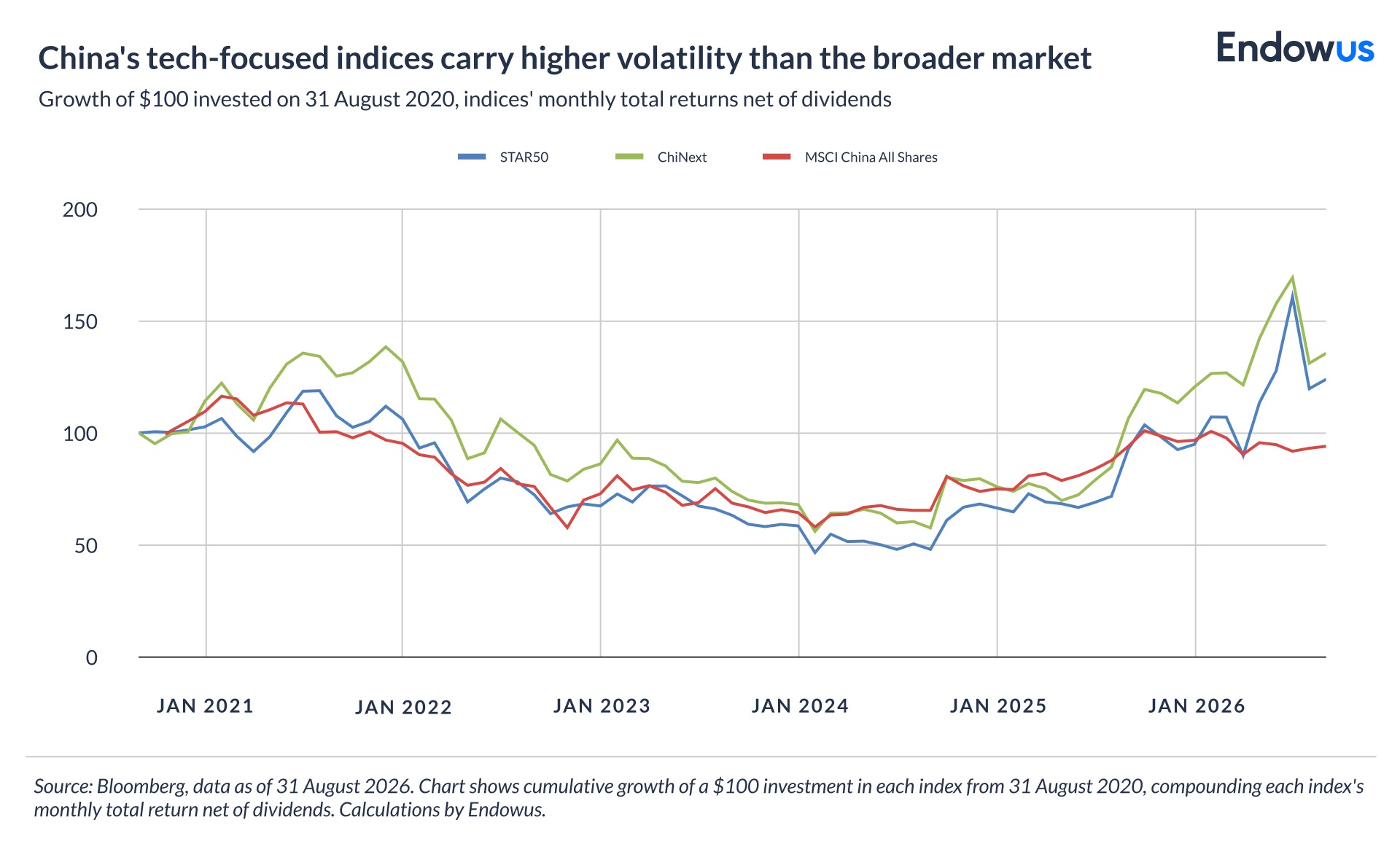
Diversification applies even within a satellite position. As we can observe below, the monthly performances of China’s tech-focused indices (STAR 50 and ChiNext) have been more volatile than the broader MSCI China All Shares index. Annualised volatility over the same 6-year period of the three indices are 35%, 33% and 22% respectively.
Hong Kong has seen a fresh surge of listings in 2025 from mainland Chinese firms that had until now traded exclusively on the Shanghai or Shenzhen exchanges. The number of mainland Chinese firms listing on the Hong Kong Stock Exchange increased from 30 in 2024, to 76 in 2025.
As AllianzGI noted, many of these newly-listed companies are regarded as among China's stronger operators, reflecting two parallel trends: a push into technology-driven innovation and a broader ambition to grow beyond domestic markets. Sectors represented span AI infrastructure, the humanoid robotics supply chain, biotech, and home appliances. The net effect is a gradually more varied offshore listings landscape.
Investors seeking alpha-generating opportunities in China, alongside a diversified core portfolio, may explore the Endowus Satellite China Equities Portfolio. It comprises five best-in-class funds focused on onshore and offshore companies, managed by globally-renowned fund houses who are experts in investing in China and Greater China markets including BlackRock, Fidelity, JP Morgan Asset Management, T. Rowe Price, and UBS Asset Management.
Webinar: Investing in a better future: Through the lens of an equity investor

Why ESG investing should matter to Singaporeans

When you can’t see the forest for the trees: A holistic approach to asset allocation


%20F1(2).webp)

.webp)
.webp)






.webp)